
Window treatments have an important job to do. They control privacy, manage sunlight, protect interior surfaces, and influence how comfortable a room feels throughout the day. Drapery and curtains can accomplish each of these goals while bringing softness, color, texture, and a tailored appearance to the window.
However, the finished result depends heavily on fit. Standard curtain panels may be too short, too narrow, or improperly proportioned for the window. They may also leave unwanted gaps or look noticeably undersized when installed in rooms with tall ceilings, wide windows, or distinctive architectural details.
Choosing custom measured drapery and curtains in Eagle allows homeowners to design treatments around their actual windows rather than adapting their homes to predetermined curtain sizes. Every important element—from the mounting height and finished length to fabric fullness, lining, and hardware placement—can be planned for the individual room.
Window Designs by Landy Brown provides personalized window treatment design, professional measurements, and installation for homeowners in Eagle, Oconomowoc, Delafield, Hartland, Pewaukee, Waukesha, and nearby southeastern Wisconsin communities. Whether a home needs elegant full-length draperies, functional privacy panels, layered treatments, or motorized coverings, custom design creates a more polished and practical result.
Why Accurate Drapery Measurements Matter
Curtains may look simple, but several measurements influence how they hang and function. The width and height of the window are only the beginning. A designer must also consider the space surrounding the window, ceiling height, nearby walls, furniture placement, trim dimensions, and the location of vents or other obstacles.
With custom measured drapery and curtains in Eagle, the treatment can be designed to work with all these details. Measurements determine where the rod or track should be installed, how far the fabric should extend beyond the window, where it should end, and how much material is needed to achieve the desired fullness.
Even a small measuring error can affect the final appearance. Panels that are too short may look unfinished. Curtains that are too long can collect on the floor or interfere with daily use. Insufficient width may prevent the panels from closing completely or cause them to look flat when drawn.
Professional measurements help prevent these problems before the fabric is ordered and fabricated.
Custom Drapery Versus Ready-Made Curtains
Ready-made curtains are manufactured in a limited selection of standard lengths and widths. Although they can provide a quick solution for some windows, they rarely account for unusual dimensions, tall ceilings, wide spans, specialty trim, or the homeowner’s exact functional needs.
Custom drapery is designed specifically for the window and room. Homeowners can choose the fabric, lining, pleat style, finished length, panel width, hardware, and operating method. This creates greater control over both the appearance and performance of the treatment.
Homeowners considering custom measured drapery and curtains in Eagle may also have access to a broader range of fabrics than they would find in a typical retail store. Instead of choosing from a few packaged options, they can compare colors, textures, patterns, and materials in the room where the treatment will actually be installed.
Custom treatments are particularly beneficial for:
- Tall or oversized windows
- Wide patio doors
- Windows positioned close to a corner
- Rooms with high or sloped ceilings
- Bay or bow windows
- Closely spaced groups of windows
- Rooms requiring greater privacy
- Bedrooms that need stronger light control
- Homes where coordinated treatments are important
- Windows that require motorized operation
The goal is not simply to cover the glass. It is to create a treatment that fits the architecture, supports the room’s function, and operates comfortably.

Creating the Right Drapery Proportions
Well-proportioned drapery can make a window appear taller and more substantial. Poorly proportioned curtains may make the same window feel smaller or visually disconnected from the rest of the room.
Mounting the hardware above the window trim can create the impression of greater height. Extending the treatment beyond the sides of the window can make the opening appear wider and allow more glass to remain uncovered when the panels are open.
The correct placement depends on the available wall space, ceiling height, window size, and desired effect. There is no single measurement that works for every room.
When designing custom measured drapery and curtains in Eagle, a professional can determine how high and wide the treatment should be installed. The final measurements account for the treatment style, hardware, fabric weight, and how much material will stack at each side when the panels are open.
Determining the Proper Fullness
Fullness refers to the amount of fabric used relative to the width the treatment must cover. Drapery generally requires more fabric than the width of the window or rod because the additional material creates folds.
Too little fullness may cause the panels to look flat or stretched when closed. Excessive fullness can create unnecessary bulk, especially around a smaller window or narrow wall.
The preferred amount depends on the heading style, fabric weight, pattern, and desired appearance. A crisp tailored pleat may require a different fabric calculation than a softer gathered treatment.
Selecting the Finished Length
Drapery can be designed to stop just above the floor, meet the floor, or extend slightly beyond it. Floor-skimming treatments provide a tailored appearance and are generally easier to maintain. Longer treatments create a softer look but may not be practical in high-traffic spaces or homes with young children and pets.
Shorter curtain lengths may be appropriate for certain windows, particularly where a radiator, built-in surface, or piece of frequently used furniture affects the available space. Custom measurements allow the length to be selected intentionally rather than determined by whichever packaged size comes closest.
Choosing Between Functional and Stationary Drapery
Functional draperies open and close across the window. They can provide privacy, reduce incoming light, and add another layer of coverage at the glass. Because they move regularly, the selected fabric, lining, hardware, and heading must support smooth operation.
Stationary panels remain at the sides of a window. They frame the opening and add color or texture while another treatment—such as a shade, blind, or shutter—provides privacy and light control.
Both approaches can be included in a plan for custom measured drapery and curtains in Eagle. The better choice depends on how the room is used.
Functional panels may be appropriate when:
- The homeowner wants full fabric coverage
- The window requires privacy after dark
- The panels need to reduce glare
- The room would benefit from an additional insulating layer
- Drapery is the primary window treatment
Stationary panels may work better when:
- A shade, blind, or shutter already controls the window
- The homeowner wants fabric without moving large panels
- Furniture would make manual operation inconvenient
- The treatment is intended primarily to frame the window
- The available stacking space is limited
A layered design can combine the visual softness of drapery with the practical operation of a separate window covering.
Fabric Selection for Custom Drapery
Fabric affects how the drapery hangs, how much light it filters, how easily it moves, and how it relates to the room. A lightweight material may create an airy appearance, while a heavier woven fabric can produce deeper folds and a more substantial treatment.
Color and pattern are important, but they should not be evaluated alone. The material’s weight, texture, durability, opacity, and response to sunlight also deserve consideration.
Homeowners selecting custom measured drapery and curtains in Eagle can view fabric samples inside their homes. This is valuable because natural and artificial light can significantly change the way a color appears. A fabric that looks neutral in a showroom may reveal warmer or cooler undertones beside the room’s flooring, walls, and window trim.
Solid Drapery Fabrics
Solid fabrics can create a calm, versatile background. Texture becomes especially important when the fabric does not include a visible pattern. Linen-inspired weaves, soft slubs, subtle sheen, and matte finishes can each create a different effect.
Neutral solids are useful when homeowners want the treatment to remain adaptable as other room finishes change. Deep colors can produce a more dramatic window treatment, particularly in rooms with large windows or generous natural light.
Patterned Drapery Fabrics
Patterns can add movement and visual interest to a window. Geometric motifs create a structured look, while botanical, abstract, and traditional patterns offer different levels of detail.
Pattern scale should relate to the size of the room and window. A very small pattern may lose its impact across large panels, while an oversized design may appear incomplete on a narrow treatment.
Custom fabrication also accounts for pattern matching. This helps motifs align consistently across seams and between adjoining panels.
Fabric Performance in Sunny Rooms
Direct sunlight can affect fabrics over time. Window direction, the number of hours of sun exposure, and the material’s composition can all influence performance.
Lining can help protect the face fabric and reduce the amount of sunlight passing into the room. A separate shade may also be layered behind the drapery to provide adjustable solar control. The appropriate solution depends on the window’s exposure and the amount of natural light the homeowner wants to preserve.
Understanding Drapery Linings
Lining is installed behind the decorative face fabric. It can improve the way the drapery hangs, provide greater privacy, protect the primary fabric, and affect how much light enters the room.
The right lining should be selected according to the room’s needs rather than added automatically without considering its effect.
Standard Lining
Standard lining provides a more finished back surface and increases opacity. It can also give lightweight fabrics additional body, helping the panels form cleaner folds.
Room-Darkening Lining
Room-darkening lining reduces the amount of light passing through the fabric. It is especially useful in bedrooms, nurseries, media rooms, and spaces where early morning or evening sunlight interferes with comfort.
Small amounts of light may still enter around the perimeter of the treatment. Mounting position, panel overlap, hardware design, and treatment width all influence the final level of darkness.
Interlining
Interlining is an additional layer placed between the face fabric and standard lining. It adds fullness and can give draperies a heavier, more luxurious appearance. This construction may also provide additional insulation at the window.
Because interlined panels are heavier, they require suitable hardware and secure installation.
Drapery for Light and Privacy Control
Different rooms require different levels of privacy. A living room facing a quiet backyard may need less coverage than a bedroom facing a neighboring property or street.
With custom measured drapery and curtains in Eagle, the width, lining, overlap, and mounting position can be planned around the privacy the room requires. Functional panels should close fully without pulling tightly across the rod or track.
Privacy also changes after sunset. A lightweight fabric that appears private during the day may reveal interior silhouettes when indoor lights are turned on. Viewing samples at the window helps homeowners better understand the material’s opacity.
Layered treatments provide additional flexibility. A shade can manage daytime privacy while the drapery remains open, and the panels can be closed when greater coverage is wanted at night.
Improving Comfort During Wisconsin Winters
Eagle and the surrounding Lake Country area experience cold temperatures throughout the winter. Glass can become one of the most noticeable sources of heat transfer in a room, especially in homes with large windows or patio doors.
Lined drapery adds another layer between the room and the window. Although it does not replace proper insulation or efficient glass, it can help reduce the sensation of cold air near the window and improve comfort in seating or sleeping areas.
Cellular shades can be layered beneath drapery when additional insulating performance is desired. The shade traps air within its honeycomb construction, while the fabric panels provide broader coverage and a finished appearance.
Designing custom measured drapery and curtains in Eagle for winter comfort requires careful attention to width and length. Panels must provide adequate coverage without blocking necessary heating vents or interfering with other room features.
During warmer months, the same treatment can help reduce direct sunlight. Closing lined draperies during periods of intense sun may make it easier to maintain a comfortable indoor temperature.
Custom Curtains for Bedrooms
Bedroom window treatments need to balance privacy, light control, comfort, and appearance. Functional drapery can provide full coverage, while stationary panels may be paired with room-darkening shades.
For homeowners who prefer a soft fabric treatment, custom curtains can be lined according to the desired level of light reduction. The panels can also be designed to overlap at the center and extend beyond the window opening to limit perimeter light.
Motorized shades placed behind stationary drapery panels are another practical option. The shades can be lowered at bedtime and raised in the morning using a remote or programmed schedule.
Hardware should be selected with the room layout in mind. If the window is behind a headboard or dresser, manual drapery may be inconvenient. A motorized track or separate motorized shade can make operation easier.
Drapery for Living and Family Rooms
Living rooms and family rooms often contain some of the home’s largest windows. They may also receive strong sunlight that creates glare or exposes furnishings to ultraviolet rays.
Custom measured drapery and curtains in Eagle can be designed to span wide window groupings while preserving access to natural light. If homeowners want the view to remain open during the day, the hardware can extend beyond the window so the panels stack primarily over the wall.
A separate shade can provide adjustable glare control without requiring the drapery to remain closed. Solar shades, roller shades, cellular shades, woven shades, or other custom coverings may be used depending on the desired appearance and performance.
In family rooms, ease of operation is particularly important. Heavy panels should move smoothly across appropriate rods or tracks. Motorization can simplify daily adjustment across wide windows and doors.
Drapery for Patio and Sliding Glass Doors
Patio doors require sufficient fabric width, durable hardware, and a clear plan for stacking the treatment. The panels should move away from the active portion of the door so they do not interfere with entry and exit.
The direction in which the door opens helps determine whether the drapery should stack to one side or divide at the center. Furniture placement and available wall space must also be considered.
Custom measurements are especially important for patio doors because packaged curtain panels may not provide enough width for full coverage. Using too few panels can make the fabric look stretched when closed.
A traverse rod or track allows wide draperies to move more smoothly. Motorized drapery tracks are another option for homeowners who want easy control without manually pulling the panels across the door.
Motorized Custom Drapery
Motorization allows drapery to open and close using a remote, wall control, app, or compatible smart-home system. Some systems can also be programmed to follow a schedule.
Motorized custom measured drapery and curtains in Eagle can be particularly useful for tall windows, wide patio doors, hard-to-reach openings, and heavy treatments. The motor moves the panels consistently without requiring homeowners to pull directly on the fabric.
Automation can support everyday routines. Draperies may be scheduled to open in the morning, close when direct afternoon sunlight enters the room, or provide privacy at sunset.
Power options vary by system. Depending on the selected product and installation, motorized treatments may use batteries, a nearby electrical connection, or wiring incorporated during construction or remodeling.
The motor, track, treatment size, fabric weight, and power source must be compatible. Planning these components together helps ensure reliable operation.
Selecting Drapery Hardware
Hardware is both functional and visible. Rods, finials, rings, brackets, and tracks must support the treatment’s weight while complementing its overall appearance.
A slender decorative rod may work for lightweight stationary panels but may not provide sufficient support for wide, lined, functional draperies. Heavy treatments can require larger-diameter rods, reinforced brackets, or specialized tracks.
The hardware finish can coordinate with other permanent finishes in the room. Black, brass-toned, silver-toned, and wood finishes each create a different effect. Decorative hardware draws attention, while concealed tracks keep the focus on the fabric.
Professional measurements identify the correct hardware length and bracket positions. Additional support may be required across a wide span to prevent the rod from bowing.
Choosing a Drapery Heading Style
The heading is the upper portion of the drapery where the fabric attaches to the rod, rings, or track. It influences the shape of the folds and the overall character of the treatment.
Pinch Pleats
Pinch pleats create evenly spaced, tailored folds. They can work with decorative rods, rings, or traverse systems and are suitable for both traditional and transitional interiors.
Ripple-Fold Drapery
Ripple-fold treatments form smooth, consistent waves across a track. Their streamlined appearance works especially well on wide windows and patio doors. Because the fullness is controlled by the track system, precise measurements are essential.
Grommet-Top Curtains
Grommets allow the fabric to slide directly along a rod. They create broad folds and a more casual look. However, furniture placement and ease of access should be considered because grommet panels are generally opened by handling the fabric.
Rod-Pocket Treatments
A rod pocket creates a gathered appearance by placing the rod through a fabric channel. This style is generally best for stationary or infrequently adjusted panels because it does not always move easily across the rod.
Custom Tailored Headings
Additional tailored heading styles can produce different fold shapes and levels of formality. The best selection depends on the fabric, treatment width, hardware, and whether the panels will open and close regularly.
Layering Draperies With Blinds, Shades, or Shutters
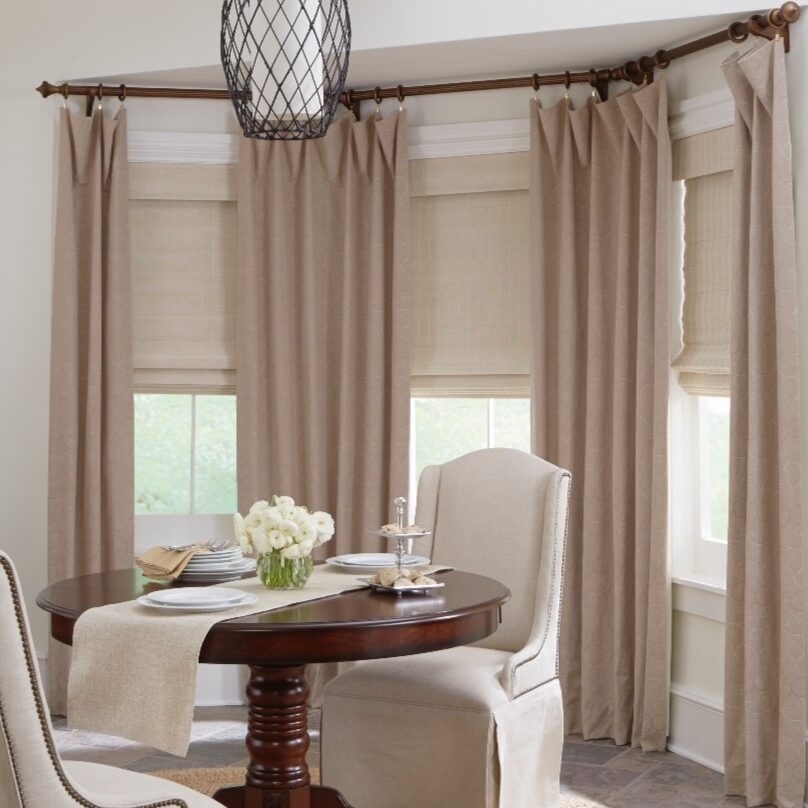
Layering allows each window treatment to perform a specific job. A blind, shade, or shutter can provide adjustable privacy and sunlight control, while drapery contributes broader coverage and a softer finish.
Popular layered combinations include:
- Stationary drapery panels with roller shades
- Lined draperies with cellular shades
- Fabric panels with plantation shutters
- Draperies with Roman shades
- Stationary panels with motorized shades
- Full-width drapery over solar shades
- Decorative panels beside woven shades
The treatments should be planned together whenever possible. Mounting depth, projection, fabric stack, hardware placement, and access to controls can otherwise create conflicts.
A shade installed too close to the drapery hardware may interfere with operation. Likewise, panels that are not wide enough may expose mounting components that were intended to remain concealed.
Treating Bay and Bow Windows
Bay and bow windows require a treatment plan that responds to multiple angles. Drapery may be installed outside the full window arrangement or fitted more closely to the individual sections, depending on the architecture and functional goals.
A single treatment positioned across the front of a bay can provide broad coverage, but it may limit access to the interior window space when closed. Individual shades within the window sections can preserve the bay’s shape, while stationary drapery panels frame the overall opening.
Professional measurements are critical because the angles, return depths, and available mounting surfaces can differ from one side to the other. Custom fabrication allows the treatments to follow the actual dimensions rather than forcing standard hardware into the space.
Correcting Common Drapery Problems
Custom design can help homeowners avoid several problems associated with poorly fitted curtains.
Panels That Look Too Short
Curtains that stop several inches above the floor may make a room look incomplete unless the shorter length is required by the window or surrounding architecture. Professional measurements establish a deliberate finishing point.
Insufficient Fabric Width
Panels should include enough fabric to close with appropriate fullness. Narrow panels can expose gaps and appear strained when pulled together.
Hardware Installed Too Close to the Window
If the rod does not extend beyond the trim, open panels may cover a large portion of the glass. This reduces natural light and makes the window appear narrower.
Fabric That Interferes With Doors or Vents
The layout should account for door movement, vents, radiators, furniture, and walking paths. A beautiful treatment should not make the room harder to use.
Incompatible Fabric and Heading Choices
Some fabrics are better suited to structured pleats, while others create softer folds. Selecting the heading without considering the fabric may result in a treatment that does not hang as expected.
Hardware That Cannot Support the Treatment
Wide lined panels can be heavy. Proper brackets, tracks, and support points are necessary for smooth, secure operation.
Professional Installation for a Finished Result
The appearance of custom drapery depends on accurate fabrication and proper installation. Hardware must be level, securely attached, and placed at the intended height. Panels may also need to be dressed so the folds fall consistently.
Professional installation is especially important for custom measured drapery and curtains in Eagle when treatments are tall, wide, lined, layered, or motorized. The installer can verify clearance, test operation, and make final adjustments.
This service also helps protect the homeowner’s investment. Custom fabric should not be placed at risk through poorly positioned brackets or hardware that is not suitable for the treatment’s weight.
Working With Window Designs by Landy Brown
An in-home consultation gives homeowners an opportunity to see fabrics and finishes in their own lighting. It also allows the designer to evaluate window dimensions, surrounding walls, furniture placement, privacy needs, and patterns of sunlight.
Window Designs by Landy Brown provides custom measured drapery and curtains in Eagle for homeowners who want treatments designed around their spaces. Landy can help clients compare fabrics, linings, heading styles, hardware, layered treatments, and motorized options.
Window Designs by Landy Brown serves Eagle, Oconomowoc, Delafield, Hartland, Pewaukee, Waukesha, and surrounding southeastern Wisconsin areas. Available window treatments include custom blinds, draperies, shades, shutters, and motorized coverings.
The process begins with understanding the room. A bedroom may need room-darkening coverage, while a living room may require glare reduction without sacrificing the view. A patio door needs easy access, and a large window may benefit from motorized operation. Each recommendation is based on the window and the homeowner’s priorities.
Schedule Your Custom Drapery Consultation in Eagle
Beautiful drapery begins with more than an appealing fabric. It requires the right proportions, adequate fullness, suitable lining, dependable hardware, and measurements that reflect the actual window.
Investing in custom measured drapery and curtains in Eagle gives homeowners control over every part of the finished treatment. Curtains can be created for privacy, light management, room darkening, seasonal comfort, or convenient motorized operation while complementing the home’s architecture.
To begin planning custom window treatments for your Eagle-area home, contact Window Designs by Landy Brown at (262) 490-1541 or email Landy@windowsbylandy.com. Schedule an in-home consultation to explore fabrics, custom drapery styles, professional measurements, and window treatment solutions created specifically for your space.
Comments are closed