
Families devote considerable attention to making their homes safer for children. They secure cabinets, cover electrical outlets, anchor furniture, and place potentially dangerous objects out of reach. However, window coverings can be overlooked during this process. Curtains, draperies, blinds, and shades may include long cords, chains, or loose fabric that can create avoidable hazards for young children.
Selecting child-safe curtain options in Pewaukee allows families to create attractive, comfortable rooms while addressing these important safety concerns. Today’s window treatments combine thoughtful operating systems, secure installation, durable materials, and customized design. Homeowners no longer need to choose between a polished interior and window coverings that work well for a growing family.
Window Designs by Landy Brown provides personalized window treatment solutions for homeowners in Pewaukee, Oconomowoc, Delafield, Hartland, Waukesha, and surrounding southeastern Wisconsin communities. From custom draperies and cordless shades to shutters and motorized coverings, every treatment can be selected for the way a room is actually used.
Why Window Treatment Safety Matters in Family Homes
Older window treatments commonly rely on dangling pull cords or continuous-loop chains. When those controls hang within a child’s reach, they can present an entanglement risk. Loose fabric can also be pulled, climbed on, or caught around nearby furniture.
Parents and caregivers should pay particular attention to windows in nurseries, bedrooms, playrooms, family rooms, and other spaces where children spend time. A window that appears safe while an infant is in a crib may require a different approach once that child begins crawling, climbing, and moving furniture.
Choosing child-safe curtain options in Pewaukee is therefore not limited to shopping for one particular fabric or style. It involves evaluating the entire window treatment, including:
- How the treatment opens and closes
- Whether cords or chains are present
- Where controls are positioned
- How securely the hardware is installed
- How far the material extends toward the floor
- Whether nearby furniture provides access to the window
- How the treatment will function as a child grows
A professionally planned design accounts for all these considerations before materials are ordered or hardware is installed.
What Makes a Curtain or Window Treatment Child-Safe?
The safest window treatment is generally one that eliminates accessible operating cords. Cordless shades, shutters, stationary drapery panels, and motorized coverings are popular choices because they can reduce or eliminate loose controls.
Safety also depends on the installation. Even a cordless product should be mounted securely with hardware appropriate for the window, wall, and weight of the treatment. Curtain rods, brackets, tracks, and decorative components should not loosen when fabric is opened or accidentally pulled.
When comparing child-safe curtain options in Pewaukee, homeowners should look beyond the appearance shown in a sample book. They should consider the treatment’s full operating system and ask how it will be used every day. A beautiful floor-length drapery may be appropriate in a formal dining room, while a shorter or more structured treatment may work better in a child’s bedroom.
The right solution is often different from room to room. A professional consultation makes it possible to coordinate the treatments visually while adapting their operation to each space.
Cordless Shades Paired With Decorative Curtain Panels
One of the most versatile designs for a family home combines a cordless shade with stationary curtain or drapery panels. The shade manages privacy and sunlight, while the side panels introduce softness, color, and texture.
Because the panels remain stationary, they do not need pull cords, traverse cords, or other accessible controls. The shade can be raised or lowered by hand using a cordless operating system. This arrangement creates the layered look many homeowners want without relying on traditional corded draperies.
For families researching child-safe curtain options in Pewaukee, this pairing offers several practical advantages:
- Flexible control over privacy and natural light
- No loose curtain cords
- Decorative fabric that does not require daily handling
- A clean, coordinated appearance
- A wide selection of shade styles and fabric combinations
Cellular, roller, Roman, and woven shades may all be considered as the functional layer, depending on the window, room, and desired appearance. Custom stationary panels can then frame the window without interfering with the cordless shade.
Cellular Shades for Bedrooms and Nurseries
Cordless cellular shades are particularly useful in bedrooms and nurseries. Their honeycomb-shaped construction traps air within the shade, helping reduce heat transfer at the window. That can make it easier to maintain a comfortable room during cold Wisconsin winters and warm summer afternoons.
Room-darkening cellular materials can also help create a restful environment for naps and early bedtimes. Light-filtering versions provide privacy while allowing a softer glow into the room.
Custom side panels can make cellular shades feel more decorative without adding complicated operating controls. This is one reason cellular shades are frequently included in plans for family-focused window treatments.
Roller Shades for Simple Daily Operation
Cordless roller shades provide a clean, uncomplicated appearance. They are easy to operate and available in a broad selection of light-filtering, privacy, and room-darkening materials.
In active spaces, such as playrooms and family rooms, the streamlined design does not introduce folds of fabric at a child’s level. Stationary curtain panels can be added when the room needs more color or softness.
Roller shades also work well with motorization. Homeowners can control the shade without reaching behind furniture, touching the fabric, or managing a hanging chain.
Stationary Drapery Panels
Stationary panels are designed to remain at the sides of a window rather than opening and closing across it. They can create the appearance of full draperies while another treatment—such as a cordless shade—provides privacy and light control.
Among child-safe curtain options in Pewaukee, stationary panels are appealing because they offer extensive design freedom. Homeowners can choose colors, patterns, textures, trims, and pleat styles that coordinate with the room. The panels can be tailored to the correct length and fullness instead of relying on one-size-fits-all curtain packages.
Stationary treatments work especially well when:
- The room already has a functional cordless shade
- The homeowner wants to add fabric without additional controls
- The window needs a taller or wider visual appearance
- The treatment will not need to close each evening
- The window is near furniture that would interfere with movable panels
The length should be considered carefully in spaces used by children. Panels that stop just above the floor may be less tempting to grab than fabric that pools extensively. The appropriate length will depend on the room, the child’s age, and the desired design.
Motorized Draperies and Shades
Motorization removes the need for accessible pull cords and allows a window treatment to be operated with a remote, wall control, app, or compatible home automation system. Depending on the selected product, treatments may also be scheduled to open and close at particular times.
Motorized systems are among the most convenient child-safe curtain options in Pewaukee because the operating mechanism is incorporated into the headrail, roller, or track. There is no need for a child or adult to tug on the fabric.
Motorization can be especially valuable for:
- Tall windows
- Wide windows
- Treatments positioned behind furniture
- Hard-to-reach windows
- Large draperies that are heavy to move manually
- Groups of windows that homeowners want to operate together
For example, motorized room-darkening shades can close automatically before a child’s bedtime. In a family room, several shades can be adjusted together when afternoon sunlight reaches the television or seating area. A motorized drapery track can move full fabric panels smoothly without a traverse cord.
Battery-Powered Options
Some motorized treatments operate using rechargeable or replaceable batteries. This can simplify installation because the treatment may not require new electrical wiring. Battery-powered options are often suitable for existing homes where homeowners want motorization without a major renovation.
The appropriate power source depends on the product, treatment size, frequency of use, and access to nearby electrical connections. These details can be reviewed during an in-home consultation.
Smart Scheduling for Consistent Light Control
Automated schedules can improve both convenience and consistency. Shades may be programmed to rise in the morning and lower in the evening, limiting the amount of manual adjustment required.
Scheduling can also help protect privacy after dark. Instead of remembering to close every treatment individually, homeowners can establish routines that fit their family’s schedule. The exact automation features will vary by motorization system, so it is important to select compatible products at the beginning of the design process.
Plantation Shutters for a Structured Alternative
Although families may begin their search by considering curtains, shutters can offer another child-conscious solution. Plantation shutters operate through hinged panels and adjustable louvers, without long hanging cords.
Shutters are securely fitted to the window and have a structured design that does not extend toward the floor. Their louvers can be adjusted to manage sunlight, visibility, and privacy throughout the day.
For homeowners evaluating child-safe curtain options in Pewaukee, shutters may be especially suitable for playrooms, children’s bedrooms, breakfast areas, and frequently used family spaces. They are durable, easy to operate, and available in finishes that complement a variety of interiors.
Shutters can also be combined with stationary fabric panels if the room would benefit from additional softness. The shutters remain the functional treatment, while the panels provide the decorative layer.
Cordless Roman Shades
Roman shades offer the tailored appearance of fabric with the compact operation of a shade. When raised, the material forms neat folds; when lowered, it creates a broad fabric surface across the window.
A cordless Roman shade allows homeowners to include custom fabric without relying on an exposed pull cord. This makes it a practical choice for rooms where the warmth of a curtain is desired but long panels would be inconvenient.
Roman shades can be customized in light-filtering or room-darkening constructions. Fabric selection is important because pattern scale, material weight, fold style, and lining all influence the finished treatment.
When professionally measured, a Roman shade can fit the window precisely and coordinate with other fabric treatments used throughout the home. It is an attractive option for nurseries, bedrooms, dining areas, and home offices.
Choosing the Right Curtain Length
Curtain length affects more than appearance. Long fabric resting on the floor can attract the attention of crawling babies and toddlers. A child may pull on the material or use it for support while learning to stand.
That does not mean every family must avoid full-length panels. It means length, placement, and function should be selected intentionally. While discussing child-safe curtain options in Pewaukee, homeowners may consider:
- Panels tailored to stop just above the floor
- Stationary panels placed outside the window opening
- Shorter treatments for windows above built-in surfaces
- Roman shades when hanging panels are impractical
- Securely installed panels with sufficient clearance from cribs and beds
- Motorized draperies that can be moved without pulling the fabric
Pooling fabric may create a luxurious effect, but it is generally less practical in rooms where young children play. A tailored, floor-skimming length can still look elegant while reducing excess material at floor level.
Selecting Fabrics for Active Family Spaces
Fabric choice affects durability, maintenance, privacy, light control, and the overall look of a treatment. In children’s rooms and shared living areas, homeowners often benefit from materials that can tolerate regular family activity.
A durable fabric does not need to feel stiff or utilitarian. Custom drapery collections include attractive woven textures, performance materials, subtle patterns, and soft neutral fabrics appropriate for refined interiors.
Consider how the fabric will respond to:
- Frequent sunlight
- Regular opening and closing
- Occasional contact from hands
- Household dust
- Changing room colors as a child grows
- The weight required by the selected hardware or motorized track
Lining can also improve a curtain’s performance. A suitable lining may provide greater privacy, reduce visible fading, improve the way the fabric hangs, or support room-darkening goals.
Room-Darkening Treatments for Children’s Bedrooms
Managing light is often a priority in nurseries and children’s bedrooms. Summer evenings remain bright later in Wisconsin, while early morning sunlight can interrupt sleep. Room-darkening window treatments help reduce incoming light and create a more consistent sleeping environment.
Homeowners exploring child-safe curtain options in Pewaukee may pair room-darkening cordless shades with custom stationary panels. Another solution is a motorized shade that can be lowered without touching cords or reaching around a crib.
No window treatment should automatically be described as producing complete darkness unless the entire installation is specifically designed for that result. Small light gaps may remain around the edges of many shades, particularly with an inside-mounted installation. Side channels, outside mounting, layering, and room-darkening fabrics may reduce those gaps.
A professional can explain what level of light control is realistic for a particular window and recommend a treatment based on the family’s sleep preferences.

Window Treatments for Playrooms
Playrooms need treatments that are simple, secure, and easy for adults to operate. Cordless roller shades, cellular shades, and shutters are frequently good fits because they avoid long loose controls.
Stationary panels can be added if they are positioned away from shelves, climbing furniture, and high-activity areas. The design should account for the room’s layout rather than considering the window in isolation.
Furniture placement is particularly important. A crib, bed, chair, toy chest, or bookcase should not provide a child with easy access to the window or treatment controls. As the room changes, families should reevaluate the furniture arrangement and confirm that cords, chains, or other components remain inaccessible.
Child-Safe Solutions for Patio Doors
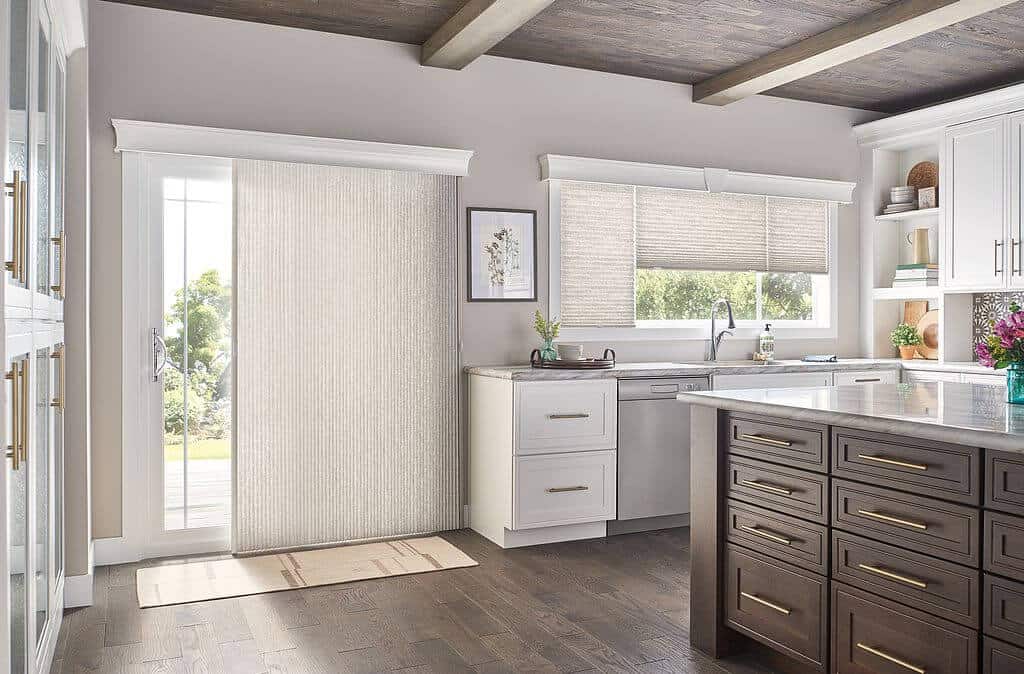
Sliding patio doors require a different approach from standard windows. The treatment must accommodate a large area of glass and allow convenient access through the doorway.
Depending on the home, suitable choices may include motorized draperies, vertical cellular shades, panel-style treatments, or other cordless systems designed for wide openings. The best option will depend on how the door opens, where the handle is located, and how frequently family members use it.
When reviewing child-safe curtain options in Pewaukee for a patio door, families should avoid controls that hang within easy reach. They should also consider whether loose fabric could become caught in the doorway or dragged across a high-traffic floor.
Accurate measurements are essential for large openings. A professionally fitted treatment is more likely to travel smoothly, stack in the intended location, and provide clear access when open.
Keeping Cribs, Beds, and Furniture Away From Windows
The safest treatment can be undermined by poor furniture placement. Cribs and children’s beds should be positioned away from windows and window coverings. This reduces access to cords, fabric, blinds, hardware, and the window itself.
Furniture arrangements may need to change as children grow. A dresser that once seemed harmless may later serve as a climbing platform. A chair placed near a stationary curtain panel could allow a child to reach the rod or brackets.
Parents should periodically inspect each room and look at the window from a child’s perspective. Can the treatment be reached from the floor? Can nearby furniture be pushed closer? Are any controls exposed? Does the hardware move when the fabric is pulled?
Window treatment safety is not a one-time decision. It is an ongoing part of maintaining a family home.
Why Custom Measurements and Installation Matter
Ready-made curtains are produced in standard widths and lengths, but residential windows are not always standard. Incorrectly sized treatments may hang too low, fail to provide adequate coverage, or require hardware to be placed in an unsuitable position.
Custom child-safe curtain options in Pewaukee can be measured for the exact window, wall, or door. The fabric length, mounting height, panel width, shade size, and hardware placement can all be planned together.
Professional installation is especially valuable for:
- Heavy drapery rods
- Motorized tracks
- Wide shades
- Plantation shutters
- Treatments mounted above a child’s bed or play space
- Specialty windows
- Layered window treatments
An installer can select appropriate mounting points and confirm that the treatment operates correctly. This creates a more finished appearance while helping ensure that the hardware remains secure during normal use.
Avoiding Common Window Treatment Safety Mistakes
A few common decisions can make an otherwise attractive treatment less suitable for a child’s room.
Keeping Old Corded Treatments Too Long
A treatment may still look good even though its operating system is outdated. Visible wear is not the only reason to consider replacement. Long cords and accessible chains deserve attention even when the shade or blind continues to function.
Assuming a Cord Cleat Eliminates Every Risk
A cleat may help keep a cord wrapped and elevated, but it depends on consistent use. A cordless or motorized product removes the need to manage an exposed pull cord in the first place.
Installing Hardware Without Considering the Treatment’s Weight
Custom draperies can be heavier than they appear. Brackets must be appropriate for the rod, fabric, lining, and span. Secure installation is particularly important where children may reach the material.
Choosing Style Before Function
Fabric is only one part of the design. Homeowners should first determine whether the treatment must provide privacy, room darkening, insulation, daily access, or automation. The decorative choices can then be made within a format that satisfies those functional needs.
Forgetting to Reevaluate the Room
A safe nursery layout may no longer be suitable when a toddler begins climbing. Window coverings and furniture placement should be reviewed as children develop new abilities.
Coordinating Safe Treatments Throughout the Home
Every room does not need an identical window treatment. However, homeowners can create visual continuity by repeating colors, fabrics, hardware finishes, or shade materials.
For example, a family might use cordless cellular shades in each bedroom, then personalize the rooms with different stationary panels. Shutters may be installed in a playroom, while a motorized roller shade handles a large family-room window. Coordinated neutral colors and consistent hardware can connect these different products.
This whole-home approach makes it possible to prioritize safety and performance without creating a disjointed interior. It also allows a family to address the most urgent rooms first and complete additional spaces over time.
Planning for Wisconsin’s Seasonal Conditions
Pewaukee homes experience cold winters, humid summers, strong sunlight, and noticeable seasonal temperature changes. Window treatments can help manage comfort by reducing direct sunlight and adding another layer at the glass.
Cellular shades are often considered when insulation is a priority. Lined draperies can provide additional coverage, while shutters offer adjustable light control throughout the year. Motorized shades can be scheduled to respond to changing sunlight patterns.
Families choosing child-safe curtain options in Pewaukee should discuss room orientation during the consultation. A west-facing bedroom may need strong afternoon light control, while a north-facing playroom may benefit from a treatment that preserves natural brightness.
Local experience is valuable because recommendations can be based on the conditions southeastern Wisconsin homeowners encounter throughout the year.
Questions to Ask During Your Window Treatment Consultation
A design consultation is an opportunity to compare materials, operating systems, and styles in the room where the treatments will be used. Helpful questions include:
- Can this treatment operate without accessible cords?
- Would a stationary panel work better than a functional curtain here?
- What is the best treatment for room darkening?
- Can this shade be motorized?
- Is battery-powered motorization appropriate for this window?
- How should the curtain length be adjusted for a child’s room?
- Where will the fabric stack when the treatment is open?
- What type of mounting hardware will be used?
- Can the treatment coordinate with coverings in adjacent rooms?
- How should the treatment be cleaned and maintained?
- Will nearby furniture interfere with its operation?
- Does the material provide the desired privacy after dark?
Bringing a list of priorities to the appointment helps the designer recommend a solution that fits the room, the family, and the homeowner’s preferred style.
Work With a Local Pewaukee-Area Window Treatment Professional
Shopping from small samples online cannot fully show how a fabric will look in a particular room or how an operating system will feel in daily use. An in-home consultation allows materials to be viewed alongside the home’s natural light, existing finishes, and window dimensions.
Window Designs by Landy Brown helps homeowners evaluate child-safe curtain options in Pewaukee with personalized recommendations. The company offers custom blinds, draperies, shades, shutters, bedding and pillows, and motorized coverings for homes in Pewaukee, Oconomowoc, Delafield, Hartland, Waukesha, and nearby communities.
During the process, Landy can help determine which windows need cordless operation, where stationary panels make sense, whether motorization would improve convenience, and which fabrics support the desired light and privacy levels. Professional measurements and installation help complete the treatment with the correct proportions and secure hardware.
Schedule a Consultation with Window Designs by Landy Brown
The best child-safe curtain options in Pewaukee are selected by considering the child, the room, the window, and the way the treatment will be used. Cordless shades, stationary drapery panels, shutters, cordless Roman shades, and motorized coverings all provide attractive possibilities for family homes.
A customized plan can improve safety without sacrificing the warmth, color, privacy, or light control homeowners expect from professionally designed window treatments.
To discuss custom window coverings for your Pewaukee or Oconomowoc-area home, contact Window Designs by Landy Brown at (262) 490-1541 or email Landy@windowsbylandy.com. Schedule an in-home consultation to compare fabrics, operating systems, and personalized window treatment solutions for every stage of family life.
Comments are closed