
Fabric can transform how a window looks and performs. It can soften strong architectural lines, filter harsh daylight, support privacy, reduce glare, and bring color or texture into a room without changing the window itself. For homeowners considering custom fabric window treatments in Sussex, the most successful design begins with practical questions about light, privacy, window dimensions, room function, and everyday operation.
Window Designs by Landy Brown provides personalized window treatment guidance for Sussex, Oconomowoc, and surrounding Wisconsin communities. An in-home consultation allows fabrics to be viewed beside the actual paint, trim, flooring, and furnishings, while professional measuring connects the design idea to the physical window. The result is a tailored treatment planned for the home rather than a standard product selected from a small online image.
What Counts as a Custom Fabric Window Treatment?
Custom fabric window treatments include several products made to fit a specific opening and meet defined goals. Draperies use fabric panels suspended from decorative or functional hardware. Roman shades raise into folds and lower into a broad fabric surface. Fabric roller and cellular shades can provide streamlined light control in a wide range of colors, textures, and opacity levels. Layered designs may combine two compatible treatments when one product alone cannot provide every desired function.
The word custom should mean more than choosing a color. Measurements, fullness, proportions, lining, hardware, control placement, mounting height, stack space, and fabric behavior all influence the finished result. A well-planned treatment should look balanced when open, closed, and viewed from across the room.
With custom fabric window treatments in Sussex, homeowners can make coordinated decisions instead of addressing fabric, function, and installation separately. That integrated process is particularly helpful for large windows, open floor plans, patio doors, bay windows, and rooms with several exposures.
Begin with the Room’s Practical Needs
It is tempting to start with pattern or color, but performance should come first. Identify what the window needs to accomplish throughout the day.
Privacy
Privacy depends on more than fabric color. Weave density, lining, room lighting, viewing angle, and time of day all matter. A sheer material may soften the view during daylight but offer little privacy after dark when interior lights are on. A lined treatment can provide stronger coverage, though light may still enter around the sides depending on the design.
Street-facing rooms, ground-level bedrooms, and windows near neighboring properties may require dependable coverage from multiple angles. Sussex properties vary from established neighborhoods to more open lots, so the exterior sightline should be evaluated at the home.
Daylight and Glare
Natural light can make a room inviting, but direct sun may create glare on televisions and monitors or make certain seats uncomfortable. Fabric opacity helps determine whether light is softly diffused, substantially reduced, or blocked more strongly.
The best custom fabric window treatments in Sussex let homeowners respond to changing conditions instead of keeping windows covered all day. A traversing drapery can move fully aside, a Roman shade can stop at different heights, and a layered design can shift between filtered light and greater privacy.
View Preservation
If a window frames a wooded yard, garden, or open Wisconsin landscape, preserving the view may be a priority. The treatment must have enough space to stack or raise clear of the glass. Hardware length, panel fullness, shade depth, and mounting position all influence how much of the view remains visible.
Temperature Comfort
Wisconsin’s cold winters and warm summers make window comfort important. Fabric, lining, construction, fit, and placement can create an additional layer at the glass. No treatment replaces effective windows or insulation, but thoughtful use may reduce the sensation of cold glass and help manage solar heat.
Custom Draperies: Flexible Style and Coverage
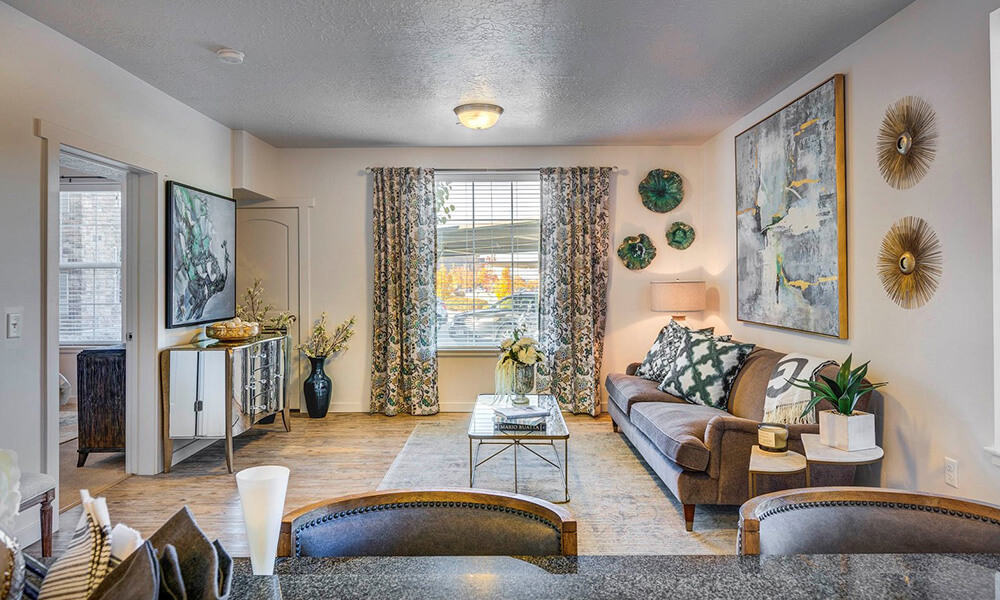
Draperies offer exceptional flexibility because fabric, heading, fullness, length, lining, and hardware can all be customized. They can frame a window as stationary side panels or traverse across it for privacy and light control.
Functional Draperies
Functional draperies open and close across the window. They can cover wide openings and patio doors, making them useful when broad, continuous coverage is needed. The design must include enough fabric fullness for the desired appearance while accounting for the stack when panels are open.
For custom fabric window treatments in Sussex, functional draperies can be tailored to the exact width, mounting height, floor relationship, and operating direction. Center-opening panels are familiar, but one-way draw may be useful when furniture, door movement, or available wall space favors a particular side.
Stationary Panels
Stationary panels remain at the sides of the window and are primarily used to frame another functional treatment. They can add softness and visual height while a shade, blind, or shutter provides everyday privacy. Because they do not need to cover the entire opening, they may require less fabric than traversing draperies.
Stationary should still look intentional. Panels that are too narrow can appear undersized, while excessive fabric may crowd the glass. Their width, mounting position, and relationship to the inner treatment should be planned together.
Fullness and Fold
Fullness describes how much fabric is used relative to the finished width. It affects the depth and richness of the folds. The appropriate amount depends on fabric weight, heading style, pattern, desired appearance, and whether the panels will move.
A lightweight sheer and a dense woven fabric do not hang the same way. Sample size matters because a small swatch cannot show the full drape, repeat, or fold behavior. Larger samples and finished display treatments provide better information.
Roman Shades: Fabric with a Tailored Profile
Roman shades combine the softness of fabric with the compact operation of a shade. When lowered, they create a broad plane across the window. When raised, the fabric forms folds near the top. Different construction styles produce flatter, softer, or more dimensional appearances.
Roman shades are particularly useful where wall space beside a window is limited. They can fit inside the opening when sufficient depth exists or mount outside to provide additional coverage and visual height. Pattern placement, seam locations, fold depth, lining, and stack size all need consideration.
Homeowners exploring custom fabric window treatments in Sussex often appreciate Roman shades in kitchens, dining areas, bedrooms, offices, and smaller living spaces. Fabric suitability should reflect the environment; windows near sinks, cooking surfaces, or persistent moisture call for careful material selection and realistic maintenance expectations.
Flat Roman Shades
Flat Roman shades have a clean face when lowered, making them well suited to patterned fabrics that should be seen without deep permanent folds. Horizontal seams or support rods may be visible depending on construction. Pattern centering becomes especially important on narrow or prominent windows.
Soft-Fold Roman Shades
Soft-fold styles maintain more visible fabric folds when lowered. They introduce additional depth and a relaxed, traditional quality. Because their construction uses more fabric and volume, homeowners should consider how the shade will look from the side and how much glass it covers when raised.
Relaxed Roman Shades
Relaxed Roman shades form a gentle curve along the lower edge. Their tailored-but-soft appearance can suit windows where perfectly rigid geometry is not required. The style may not raise or align in the same precise manner as a flat construction, so appearance and operation should be discussed before ordering.
Fabric Roller and Cellular Shades
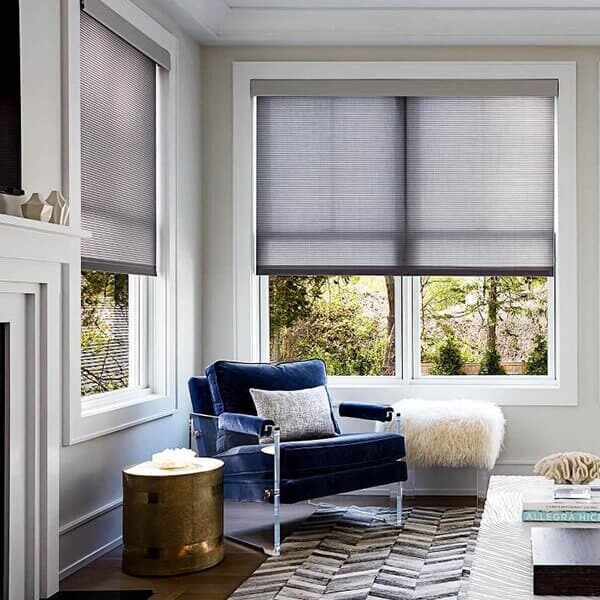
Not every fabric treatment needs pronounced folds. Roller shades offer a streamlined profile, while cellular shades create even horizontal pleats. Both are available in textile-like colors and textures that can coordinate with a room without occupying the visual space of full drapery.
Roller Shades
Roller shades roll neatly near the top of the window and present a flat surface when lowered. Fabric choices may range from open weaves that preserve some outward visibility to light-filtering and room-darkening materials. Openness and opacity are different concepts, so homeowners should ask what can be seen through the material during both daytime and nighttime conditions.
Decorative roller fabrics can stand alone or sit beneath side panels. In layered custom fabric window treatments in Sussex, the roller shade can handle frequent privacy and glare adjustments while drapery panels add softness and scale.
Cellular Shades
Cellular shades use a honeycomb-like construction that traps air within pockets. Their compact folds and broad color selection make them versatile for many rooms. Depending on the collection, options may include varied cell sizes, opacity levels, and top-down/bottom-up operation.
A top-down/bottom-up shade can be useful where privacy is needed at eye level but daylight is welcome above. Compatibility, cord-free operation, and window dimensions should be confirmed for the selected product.
Understanding Fabric Opacity
Opacity is one of the most important performance decisions. Names vary by manufacturer, but fabrics generally fall along a range from sheer to room darkening.
Sheer Fabrics
Sheers soften sunlight and reduce the visual hardness of bare glass. They can preserve a sense of openness during daylight but usually provide limited privacy at night. Exterior views may also change based on which side of the fabric is more brightly lit.
Light-Filtering Fabrics
Light-filtering materials diffuse daylight while providing more coverage than an open sheer. The exact privacy level depends on color, weave, lining, and room lighting. Pale materials may glow beautifully, while darker colors can produce a more dramatic effect.
Room-Darkening Fabrics and Linings
Room-darkening materials reduce substantially more light and are often considered for bedrooms, nurseries, and media rooms. They do not guarantee complete blackout. Light can enter at the sides, top, center opening, or floor depending on the treatment and mounting method.
When specifying custom fabric window treatments in Sussex, homeowners should define the desired result clearly. “Less glare,” “strong nighttime privacy,” and “a very dark bedroom” are different goals that may require different fabrics, linings, layers, and installation details.
The Role of Lining
Lining influences appearance, body, privacy, light control, and how the exterior side of a treatment looks. It can help a face fabric hang more smoothly and create a consistent backing visible through the window.
Standard lining may add structure and privacy. Room-darkening lining reduces more light. Interlining places an additional layer between the face fabric and lining, adding body and a fuller hand. Not every combination is suitable for every fabric or treatment style, and additional layers affect weight and stack.
The lining color can also influence the face fabric, especially when the material is light or loosely woven. Viewing a proposed combination together is more informative than selecting each component separately.
Pattern Scale, Placement, and Repeats
Pattern can be subtle or bold, but it must be planned at the scale of the finished treatment. A large botanical, stripe, plaid, or geometric motif may require careful centering and matching across seams or multiple windows.
Repeat size affects fabric quantity. Matching a pattern can require additional yardage so motifs align consistently. On Roman shades, the visible pattern changes as the shade is raised. On draperies, folds may conceal and reveal different parts of the design.
For multiple custom fabric window treatments in Sussex, professional planning helps establish where motifs begin, how adjacent panels relate, and whether separate windows should mirror or coordinate. Exact pattern matching may be limited by fabric characteristics and window dimensions, but expectations should be discussed in advance.
Stripes and Plaids
Linear patterns reveal irregularities quickly. Stripes should appear appropriately vertical or horizontal, and plaid lines should align across joined widths where construction allows. The window itself may not be perfectly square, so the treatment must be fabricated and installed to look balanced in the room.
Large-Scale Prints
Large motifs need enough visible area to read clearly. A narrow shade may show only a fragment, while a broad drapery panel can display the pattern more fully. A mockup or careful review of the repeat can help homeowners understand the likely result.
Textured Solids
Solid fabric does not have to be visually flat. Slubs, woven threads, subtle sheen, and tonal variation can add depth without introducing a distinct motif. Texture is especially useful when the room already contains patterned rugs, upholstery, or architectural details.
Hardware Is Part of the Window Treatment
Drapery hardware affects both function and proportion. Rod diameter, finish, brackets, rings, carriers, finials, returns, and support locations all contribute to the finished design. Hardware must support the weight of the selected fabric, lining, and treatment width.
Decorative rods and rings remain visible and can reinforce the room’s style. Traversing systems conceal much of the operating mechanism and may provide smoother movement across wide spans. Some systems can be motorized for convenient control.
Mounting height changes the apparent scale of the window. Installing above the casing can create visual height and preserve more glass when panels are open, but ceiling lines, crown molding, vents, and available wall space impose limits. Bracket placement must also account for a secure mounting surface.
With custom fabric window treatments in Sussex, hardware should be specified at the same time as fabric and construction. Choosing it afterward can create problems with weight capacity, projection, stack space, or finished length.
Precise Measuring and Proportion
Custom fabrication relies on accurate field measurements. Width and height are only the beginning. The professional must evaluate casing, sill projection, window depth, handles, locks, adjacent walls, ceiling height, floor level, furniture, vents, and door movement.
For draperies, the plan should establish finished length, rod height, returns, overlap, center opening, and available stacking space. Floors are not always level, particularly across a wide opening, so measurements may need to be taken at several points.
For shades, inside mounting requires adequate depth and a reasonably suitable opening. Outside mounting can provide greater coverage or make a small window appear larger, but it needs clear wall space and secure bracket locations.
Professional measurement also protects pattern placement. A Roman shade with a centered motif or a pair of drapery panels with matched repeats requires fabrication dimensions that reflect the final mounting position.
Layering Fabric with Blinds, Shades, or Shutters
Layering is useful when one treatment provides practical control and another contributes softness or broader coverage. Drapery panels can frame a blind, shade, or shutter. A Roman shade can be paired with functional draperies when flexible daytime filtration and stronger evening privacy are both priorities.
Layers must fit physically. The inner treatment needs enough mounting depth, while the outer hardware requires sufficient projection to clear it. Window cranks, handles, and trim can affect both. The combined stack should not block excessive glass or interfere with doors.
The strongest layered custom fabric window treatments in Sussex assign a clear purpose to every component. Adding layers without a functional or visual reason can make a window feel crowded. A coordinated design uses compatible proportions, colors, and operating methods.
Motorized Fabric Window Treatments
Motorization can make fabric shades and traversing draperies easier to operate, particularly on tall windows, broad openings, patio doors, or treatments located behind furniture. Compatible systems may use a handheld remote, wall control, app, smart-home platform, or scheduled routine.
Power options can include batteries, rechargeable motors, plug-in systems, or hardwiring. The correct choice depends on product compatibility, treatment weight, access, room design, and whether the home is finished, under renovation, or being built.
Motorized draperies can open smoothly without repeated handling of the fabric. Motorized shades can stop at consistent positions across a group of windows. This may help align treatments in open living areas and simplify daily glare or privacy adjustments.
Technology should remain easy to use. Homeowners should ask which controls are included, whether a hub is required, how the treatment works during an internet outage, and how batteries will be charged or replaced. Manual override features vary by system.
Planning Fabric Treatments Room by Room
Living Rooms
Living rooms often require a balance of view, daylight, privacy, and visual scale. Full-height draperies can soften a broad wall and frame an outdoor view, while Roman or roller shades provide compact control. Fabric should be considered from all primary seating positions.
Dining Rooms
Dining rooms can accommodate pattern, texture, and more formal tailoring. Functional draperies provide evening privacy, while stationary panels can frame another treatment. Hardware and heading style should relate to the room’s architecture without overpowering it.
Bedrooms
Bedrooms usually prioritize privacy and stronger light reduction. Lined Roman shades, room-darkening roller shades, or functional draperies may be considered. Because small light paths remain around most treatments, homeowners who need a very dark room should discuss layers and mounting details.
For bedrooms, custom fabric window treatments in Sussex can be designed around sleep needs, window orientation, furniture placement, and the frequency of operation. A beautiful treatment is only successful if it closes easily every night.
Kitchens
Kitchen fabrics need thoughtful placement. Windows near sinks or cooking surfaces may experience moisture, grease, and frequent cleaning. Streamlined roller or cellular products may be more practical than absorbent, highly detailed fabrics in active areas. Roman shades can work in suitable locations when material and care requirements are understood.
Home Offices
In a home office, fabric can soften glare and improve the visual background for calls. A shade allows quick adjustment as the sun moves, while side panels can make the workspace feel more finished. Screen position and the window’s direction should guide opacity.
Patio Doors
Patio doors require clearance, smooth movement, and access to handles. Traversing draperies can cover a broad span, but stack location should support the direction of traffic. Motorization may be helpful on frequently used openings when the selected system is appropriate.
Caring for Fabric Window Treatments
Care depends on fiber content, weave, dye, lining, construction, and hardware. Homeowners should receive specific instructions for the selected product rather than relying on a universal cleaning method.
Routine dust removal may involve a soft brush attachment at low suction, a clean duster, or gentle shaking where appropriate. Spot cleaning can create rings, color changes, or water marks on some fabrics. When deeper cleaning is required, a professional method may be recommended.
Repeated handling can transfer skin oils to edges and folds. Wands, batons, cords, or motorization can reduce direct contact depending on the treatment. Keep fabric clear of damp floors, wet counters, cooking splatter, and open flames.
Sunlight may alter fabric color over time. Linings and appropriate product selection can help manage exposure, but no textile is completely immune to fading. Rotation is not practical for fixed treatments, so high-sun windows deserve careful fabric and lining choices.
Common Mistakes to Avoid
One common mistake is selecting from a tiny swatch. A small piece cannot show pattern scale, drape, seam placement, or how light passes through the full treatment. Larger samples offer a better understanding.
Another is ignoring stack space. Draperies and Roman shades occupy space when open. If preserving the view is important, the design must provide room for the fabric to move away from the glass.
Homeowners may also choose opacity based only on daytime appearance. A material that seems private while the exterior is bright can reveal silhouettes after dark. Evaluate the proposed treatment under realistic lighting conditions.
Finally, avoid treating fabrication and installation as separate afterthoughts. In custom fabric window treatments in Sussex, fabric weight, hardware capacity, mounting height, finished length, and operating method are connected. Changing one element can affect the others.
Questions to Ask During an In-Home Consultation
A detailed consultation should answer practical and design questions, including:
- Which treatment type best meets the room’s privacy and light needs?
- How will the fabric look with daylight behind it?
- Is a lining recommended, and what will it change?
- How much fabric fullness is appropriate?
- Where will the pattern begin, and how will repeats align?
- How much glass will be covered when the treatment is open?
- What hardware can support the finished weight?
- Will the treatment clear locks, handles, vents, and furniture?
- Is inside or outside mounting more suitable?
- Which cordless or motorized controls are available?
- What care method does the fabric require?
- What product and installation warranty information applies?
These questions help translate a preferred look into a treatment that performs well in daily use.
Local Design for Sussex and the Oconomowoc Area
Homes in Sussex, Oconomowoc, and surrounding communities range from established traditional properties to newer open-concept construction. Some rooms feature detailed woodwork and individual windows, while others use broad glass doors and grouped windows. Local design service makes it possible to respond to those differences accurately.
Wisconsin seasons also affect how homeowners use their windows. Low winter sun may create glare from a different angle than summer light, and cold glass can influence comfort near seating areas. A treatment should be selected with year-round conditions in mind.
Window Designs by Landy Brown offers blinds, draperies, shades, shutters, and motorized coverings, allowing fabric treatments to be considered alongside other functional options. For homeowners researching custom fabric window treatments in Sussex, an in-home consultation provides the opportunity to compare samples, assess sightlines, confirm measurements, and develop a coordinated solution.
Bringing the Complete Window Together
A successful fabric treatment feels inevitable in the room. Its proportions suit the window, the material supports the needed privacy and light control, the hardware carries the correct scale, and the controls are convenient to use. Pattern and color matter, but they are most effective when supported by sound planning.
Custom work is particularly valuable when windows are wide, tall, grouped, unusually shaped, or positioned near doors and built-ins. It also helps when several rooms need to coordinate without becoming identical. One fabric can inspire a palette, while different treatment types respond to each window’s practical needs.
Thoughtfully designed custom fabric window treatments in Sussex can make daylight more comfortable, create dependable privacy, and bring softness to the architecture. Professional fabrication and installation complete the process so panels hang correctly, shades operate smoothly, and hardware is positioned securely.
Schedule a Personalized Window Treatment Consultation
If you are considering custom fabric window treatments in Sussex, Window Designs by Landy Brown can help you compare fabrics, linings, treatment styles, hardware, and motorized options in your home. The consultation can address privacy, glare, view preservation, window access, and coordination with existing finishes.
Window Designs by Landy Brown serves Sussex, Oconomowoc, WI, and surrounding areas with custom blinds, draperies, shades, shutters, and motorized coverings. Schedule a personalized consultation to begin planning window treatments designed for your rooms and routines.
Call (262) 490-1541 or email Landy@windowsbylandy.com to get started.
Comments are closed