
Window treatments play an important role in a child’s bedroom, nursery, playroom, and family living areas. They manage sunlight, create privacy, support comfortable sleep, and contribute color and softness to the room. Their operating systems, hardware, length, and placement also deserve careful consideration when young children are present. Professionally designed child-safe curtain options in Waukesha can help families create attractive rooms while avoiding unnecessary operating cords and other preventable concerns.
Window Designs by Landy Brown provides custom draperies, shades, blinds, shutters, and motorized coverings for homeowners in Waukesha, Oconomowoc, and surrounding Wisconsin communities. An in-home consultation allows parents and caregivers to compare fabrics, linings, controls, and installation choices beside the actual windows where the treatments will be used.
What Makes a Curtain More Appropriate for a Child’s Room?
No curtain can replace attentive supervision or general household safety practices. However, thoughtful product selection can remove or reduce features that may be unsuitable around young children.
Traditional window coverings sometimes use accessible cords, continuous loops, or other controls that can create entanglement hazards. Safer alternatives include stationary drapery panels, cordless window treatments, properly designed motorized systems, and traversing curtains operated with a baton rather than a loose cord.
The safest configuration depends on the room and how the treatment will function. Curtains that simply frame the window have different operating requirements from panels that need to open and close every day. Selecting child-safe curtain options in Waukesha should therefore involve a complete review of the treatment’s fabric, controls, hardware, furniture placement, and intended use.
Why Custom Design Is Valuable for Families
Ready-made curtains are manufactured in predetermined lengths and widths. Those dimensions may not work properly with the window, wall, or furniture arrangement in a nursery or child’s bedroom.
Panels that are excessively long can pool across the floor, where a crawling child may grab or become caught in the fabric. Curtains that are too narrow may not close fully enough to provide the privacy or light control the room needs. Lightweight hardware selected without regard to the fabric’s weight may not support the treatment adequately.
Custom curtains are planned for the individual window. Their length, fullness, lining, hardware, and operating method can be selected according to the room’s exact conditions.
During an in-home consultation, Window Designs by Landy Brown can assess window dimensions, trim, wall space, ceiling height, heating vents, nearby furniture, and other features that may influence the treatment.
Stationary Drapery Panels
Stationary panels are designed primarily to frame a window rather than traverse across it. Because they do not need a conventional opening and closing mechanism, they can provide decorative softness without an accessible lift or traverse cord.
These panels may work well when another cordless treatment provides functional privacy and light control. For example, stationary draperies can frame a cordless shade that raises and lowers within the window opening.
Among the available child-safe curtain options in Waukesha, stationary panels offer substantial design flexibility. Families can choose fabric colors, textures, patterns, headings, and linings that coordinate with the room while relying on a separate child-conscious product for daily operation.
Stationary panels should still be positioned thoughtfully. A young child may pull on fabric that hangs beside a crib, bed, changing table, chair, or toy storage unit. Furniture placement and panel length should be evaluated as part of the design.
Baton-Operated Draperies
Functional draperies can sometimes be opened and closed with a baton attached near the leading edge of the panel. The adult uses the baton to move the curtains along a compatible traversing rod or track.
This approach eliminates the need to pull directly on the fabric and avoids a traditional loose traverse cord. It can be helpful for curtains that need to close across a bedroom window each evening.
The baton’s length and position should be selected with the household in mind. It needs to be accessible to the adults operating the treatment without becoming an inviting play object for a child.
A properly specified track is equally important. The hardware must support the weight and width of the lined curtains while allowing the carriers to move smoothly. If the treatment is difficult to operate, adults may pull on the fabric or hardware, creating unnecessary wear.
Motorized Curtains
Motorization can provide convenient cord-free operation for functional draperies. With a compatible system, the panels travel along a powered track using a remote, wall control, application, or programmed schedule.
Motorized child-safe curtain options in Waukesha can be particularly useful for broad bedroom windows, patio doors, windows located behind furniture, or curtains that open and close at the same times each day.
Parents may program the curtains to open after a child’s usual wake-up time and close before bedtime. They can also operate the treatment without reaching behind a crib, dresser, chair, or play area.
Product compatibility depends on the curtain’s weight, width, heading, track, power source, and selected control system. Motorized hardware must be professionally planned and securely installed. Cables, power components, remotes, and other accessories should be positioned according to product instructions and kept appropriately managed.
Pairing Curtains with Cordless Shades
Layering stationary or functional curtains with a cordless shade can create a flexible window treatment for a child’s room.
The shade provides adjustable privacy and light control. The curtains add softness, color, pattern, and broader visual framing. Depending on their construction, the curtains may also close for an additional layer of coverage.
Cordless shade options may include cellular shades, roller shades, Roman shades, or other products, subject to the window’s dimensions and the manufacturer’s available controls. Some are raised by gently lifting the bottom rail, while others use a handle or motor.
When combining treatments, the products must not interfere with one another. Hardware projection, shade depth, fabric fullness, window handles, and available wall space should all be evaluated.
Cellular Shades for Nurseries and Bedrooms
Cellular shades are a popular companion to custom curtains because their structured pockets provide a soft appearance and can add insulation at the window.
Light-filtering cellular shades diffuse natural light while maintaining a bright room. Room-darkening versions block more light and may be appropriate for nurseries, bedrooms, and households with daytime sleep schedules.
Cordless cellular shades are usually operated from the bottom rail or an integrated handle. Motorized versions may be available for windows where manual access is inconvenient.
When discussing child-safe curtain options in Waukesha, cellular shades may be recommended as the functional layer behind drapery panels. Curtains can contribute the desired fabric design, while the shade handles frequent light and privacy adjustments.
Homeowners should understand that a room-darkening shade does not always create complete darkness. Light can remain around the edges, depending on the mounting method and window construction.
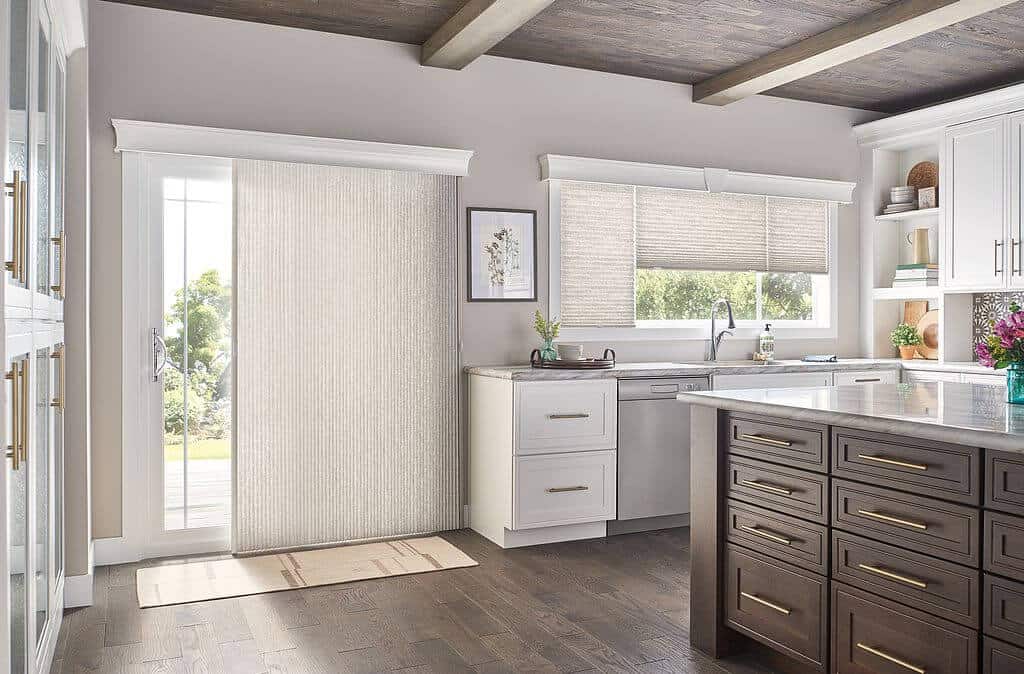
Cordless Roller Shades with Curtains
Roller shades have a streamlined profile and are available in fabrics ranging from softly light filtering to room darkening. When raised, the material rolls compactly near the top of the window.
A cordless or motorized roller shade can work behind decorative curtain panels without adding a visible operating cord. This combination is suitable for contemporary, transitional, and traditional rooms, depending on the selected fabrics.
Roller shades typically have small gaps between the fabric and the sides of the window opening, particularly with an inside mount. Families seeking stronger room darkening should discuss outside mounting, broader coverage, or appropriate supplemental layers.
The shade fabric and curtain material do not need to match exactly. Coordinating colors and textures can create a more natural, layered appearance.
Roman Shades as a Soft Layer
Roman shades provide adjustable fabric coverage and form folds as they rise. They can coordinate beautifully with drapery panels, creating a fully tailored soft-treatment design.
Cordless and motorized operating systems may be available for compatible Roman shades. The construction, dimensions, fabric, lining, and lift system must be selected together.
Because Roman shades contain fabric folds, professional design and operation are important. The shade should raise evenly, fit the window properly, and remain free from nearby objects that could obstruct its movement.
A Roman shade paired with stationary panels can be one of the more decorative child-safe curtain options in Waukesha, especially when families want softness without using a traditional exposed cord system.
Selecting an Appropriate Curtain Length
Floor-length curtains create strong vertical lines and can make a room feel taller. In a space used by young children, however, the fabric should not pool excessively across the floor.
Puddled draperies use additional fabric to create a luxurious effect at the bottom. Although visually dramatic in some adult spaces, pooled fabric can be tempting for children to handle, sit on, hide objects beneath, or pull.
A tailored treatment that finishes at or just above the floor generally creates a cleaner arrangement. Precise measurement matters because floors are not always perfectly level.
Short curtains may be considered when furniture, vents, or other conditions make full-length panels impractical. Their proportions must be planned carefully so they relate naturally to the window rather than looking unintentionally undersized.
Keeping Curtains Away from Cribs and Beds
A crib should not be positioned where a child can reach curtains, shade controls, or window treatment hardware. As children grow and learn to stand or climb, their reach can change quickly.
Beds, bunk beds, chairs, toy chests, bookshelves, and changing tables can also give children access to a window and its treatment. A safe arrangement considers not only the child’s current abilities but also how the room may be used later.
Even thoughtfully selected child-safe curtain options in Waukesha require appropriate furniture placement. Curtains should not hang where a child can repeatedly pull on them, wrap fabric around the body, or use them to place force on the hardware.
Families should periodically reassess the room. Moving a bed or adding new furniture can create access that did not exist when the treatment was installed.
Selecting Secure Curtain Hardware
Curtain rods and tracks must be attached securely to an appropriate mounting surface. The brackets and fasteners should be selected for the treatment’s weight, width, operation, and wall construction.
Decorative tension rods are not appropriate for every window or treatment. A rod that relies only on pressure may be dislodged if the curtain is pulled. Professional installation helps ensure that the selected hardware suits the application.
Finials, rings, wands, batons, brackets, and other components should also be considered. Loose or damaged pieces require prompt attention.
Motorized tracks need suitable electrical planning and secure mounting. Their travel path should remain clear, and the system should be operated according to the manufacturer’s instructions.
Fabric Weight and Construction
Curtain fabric influences more than color and pattern. Weight, weave, fiber content, lining, and construction all affect how the panels hang and how much force they place on the hardware.
A lightweight fabric can create an airy appearance, while a substantial material produces fuller folds. Lining adds body and can improve privacy or light control, but it also increases the treatment’s total weight.
The hardware must be specified for the completed curtain, including the face fabric, lining, interlining when used, heading, rings, and overall width. Selecting a rod based only on an unlined fabric sample can lead to inadequate support.
A custom consultation connects the material selection with the hardware requirements from the beginning.
Light-Filtering Curtains for Playrooms
Playrooms often benefit from natural light, but direct sunlight can make the space excessively bright or create glare on screens and activity surfaces.
Light-filtering curtains diffuse incoming light while preserving a welcoming daytime atmosphere. Their exact performance depends on the fabric’s density, color, construction, and lining.
Privacy should still be considered. Some light-filtering materials provide limited coverage at night, particularly when the room is brightly illuminated. Pairing curtains with a cordless shade can provide additional control.
For playrooms, child-safe curtain options in Waukesha should be easy for adults to operate and positioned away from climbing furniture. The fabric should not obstruct floor vents, doors, or frequently used storage.
Room-Darkening Curtains for Better Sleep
Room-darkening curtains can help reduce outside light in nurseries and children’s bedrooms. They may be useful during daytime naps, early summer sunrises, or evenings when outdoor light remains visible near bedtime.
The lining determines much of the curtain’s light-control performance. A room-darkening lining can block more light through the primary fabric while allowing families to choose from a broader range of decorative materials.
Light may still enter above, below, or beside the curtains. Extending the rod beyond the window and selecting suitable returns may improve side coverage. Layering the curtains with a room-darkening shade can provide further control.
Parents should communicate how dark they want the room to become. “Room darkening” is a general category, and the final result depends on the complete installation rather than fabric alone.
Managing Privacy in Street-Facing Rooms
Children’s bedrooms and playrooms may face roads, sidewalks, neighboring homes, or shared outdoor spaces. Privacy should be evaluated during both daylight and nighttime conditions.
Sheer curtains can soften the view during the day but generally do not create dependable privacy after dark. When interior lights are on, silhouettes and room details may remain visible from outside.
Lined curtains, opaque Roman shades, roller shades, cellular shades, blinds, or shutters can provide stronger coverage. Layering allows families to enjoy softer daylight while retaining a more private option for evening.
The treatment should be simple enough that adults will use it consistently. Motorization and grouped controls may be beneficial when several windows need to close at the same time.
Choosing Colors and Patterns That Can Grow with the Child
Children’s interests change quickly. A strongly themed curtain may feel exciting for a short period but become outdated as the child grows.
A more adaptable treatment can still include color and personality. Geometric patterns, subtle prints, textured solids, checks, stripes, and nature-inspired designs can suit a child’s room without being tied to one temporary interest.
Families may also choose a versatile curtain fabric and allow smaller, easily changed items elsewhere in the room to carry a current theme. This can extend the useful design life of a custom treatment.
During an in-home consultation, samples can be compared with the existing walls, flooring, furniture, and natural light. A color that looks muted in a sample book may become much brighter when used across full-length panels.
Child-Conscious Treatments for Shared Family Rooms
Window safety is not limited to nurseries and children’s bedrooms. Family rooms, living rooms, dining spaces, and home offices may be used by children every day.
Accessible cords and poorly positioned treatments can present concerns anywhere in the home. Visiting grandchildren, relatives, or family friends may also spend time in rooms that are not usually considered child-focused.
Homeowners evaluating child-safe curtain options in Waukesha may therefore want to assess every window accessible to young children. Updating priority rooms first is possible, but the broader household should remain part of the plan.
Stationary panels, cordless shades, shutters, blinds with appropriate controls, baton-operated curtains, and motorized systems can be considered according to each room’s needs.
Benefits of Motorized Scheduling
Motorized curtains and shades can be programmed to move at selected times, depending on the control system. This feature supports consistent privacy and light management without requiring someone to enter the room and adjust the treatment manually.
In a nursery, a motorized shade might lower before an afternoon nap. Bedroom curtains could close as part of an evening routine and open after the household’s preferred wake-up time.
Scheduling should remain flexible. Families may need different settings on weekends, during school breaks, or as a child’s sleep schedule changes.
Remote controls should be stored where adults can access them without making them toys. Applications and connected controls should be configured according to the household’s preferences.
Avoiding Accessible Loops and Loose Controls
When evaluating a window treatment, homeowners should look beyond the main curtain panels. Any operating cords, chains, loops, tiebacks, tassels, or loose accessories deserve consideration.
Decorative tiebacks may hang within reach or include small detachable components. Long cords or loops should not be treated as harmless simply because they are positioned beside rather than directly on the window.
The simplest treatment often reduces the number of loose elements. Stationary panels without tiebacks, baton-operated traversing curtains, and motorized tracks can create orderly designs with fewer accessible controls.
A professional can explain how each proposed treatment operates and identify the components that will remain visible after installation.
Why Professional Measurement Matters
Accurate measurement helps curtains fit the window, hang at an appropriate length, and operate without interfering with surrounding objects.
The process involves more than recording the width and height of the glass. The consultant should consider trim, ceiling height, floor level, available wall space, furniture, heating elements, vents, door swings, window handles, and the intended mounting position.
For layered child-safe curtain options in Waukesha, measurement must account for both products. A shade installed inside the frame needs sufficient depth, while curtain hardware must project far enough for the panels to move without catching on the treatment behind them.
Custom measurements also help determine the correct curtain fullness. Panels need enough fabric to create attractive folds and close adequately without becoming unnecessarily bulky.
Professional Installation and Final Testing
Secure installation is essential in rooms used by children. Brackets, tracks, rods, and motorized components should be attached using hardware appropriate for the wall or mounting surface.
After installation, the treatment should be tested in every position. Curtains should traverse smoothly, shades should raise evenly, and motorized systems should stop at their programmed limits.
The installer can demonstrate the correct operating method and explain routine care. Parents should know how to use every control, replace or recharge batteries when applicable, and identify movement that may require professional attention.
Furniture should be reviewed again after installation. A treatment that is securely mounted can still become accessible if a crib, bed, chair, or storage unit is placed directly beneath it.
Routine Inspections for Family Window Treatments
Children grow, furniture moves, and household routines change. Periodic checks help families recognize when a previously suitable arrangement needs to be updated.
Homeowners should inspect curtain hardware for looseness, bent components, or visible damage. Panels should move smoothly without requiring excessive force. Motorized tracks should operate without unusual sounds or inconsistent movement.
Curtains and shades should remain free from objects that obstruct their travel. Toys, books, furniture, and decorations can interfere with the lower edge of a shade or the path of a traversing curtain.
If a product is damaged, families should avoid temporary repairs that introduce loose cords, tape, wire, or other inappropriate components. Professional repair or replacement is the safer approach.
Cleaning Curtains in Children’s Rooms
Children’s rooms can expose curtains to dust, fingerprints, and normal household activity. The correct cleaning method depends on the fabric, lining, construction, trim, and hardware.
Some custom fabrics may require professional cleaning. Others may permit gentle dust removal or careful vacuuming with a suitable attachment. Homeowners should follow the specific care instructions provided with the treatment.
Machine washing should never be assumed to be safe. Water, heat, and agitation can cause shrinkage, color changes, distorted linings, or altered folds.
Using a baton or motorized system can reduce direct handling of the curtain fabric. Keeping the panels clear of floors and frequently touched surfaces may also help them remain cleaner.

Preparing for an In-Home Consultation
Before meeting with a window treatment professional, families may want to identify the windows that children can access and the problems each room needs to solve.
Useful details include:
- The child’s age and current mobility
- Whether the room is used for sleeping or play
- When direct sunlight reaches the window
- Daytime and nighttime privacy needs
- The location of cribs, beds, chairs, and storage
- Whether curtains will open and close daily
- Desired light-filtering or room-darkening performance
- Interest in cordless or motorized operation
- Existing treatments that may remain
- Colors and patterns already used in the room
- Plans to rearrange furniture as the child grows
Families do not need to know the correct product in advance. The consultation is an opportunity to compare alternatives and understand how each one would function in the room.
Questions to Ask Before Choosing a Treatment
Parents and caregivers should receive clear information about the treatment’s operation, installation, and care. Helpful questions include:
- Does the treatment have any accessible operating cords or loops?
- Can it be operated with a baton or motor?
- Is a cordless shade available as a functional layer?
- Where will the curtain hardware be mounted?
- Is the proposed length suitable for the room?
- Will the fabric hang near a crib, bed, or chair?
- What light-control level will the lining provide?
- How much privacy will the treatment offer at night?
- Are small or detachable accessories included?
- How should the curtains be cleaned?
- What maintenance does the hardware require?
- Can the treatment adapt when the furniture arrangement changes?
- What should be done if the track or control is damaged?
- How will a motorized system receive power?
- Can several windows be controlled together?
These conversations help families compare child-safe curtain options in Waukesha according to their complete design rather than one feature alone.
Custom Window Treatments for Waukesha Families
A family-friendly window treatment should manage light and privacy while fitting naturally into the room’s routines. Stationary panels, baton-operated draperies, motorized curtains, and curtains layered with cordless shades can all offer advantages when properly selected and installed.
The right solution depends on the child’s age, the window’s location, furniture placement, desired light control, and how frequently the treatment will operate. These details are difficult to evaluate from standard product photographs or approximate measurements.
Window Designs by Landy Brown serves Waukesha, Oconomowoc, and surrounding Wisconsin communities with custom draperies, shades, blinds, shutters, and motorized coverings. An in-home consultation gives families the opportunity to review fabrics, linings, hardware, operating systems, and placement in the space where the treatment will be installed.
For personalized help exploring child-safe curtain options in Waukesha, contact Window Designs by Landy Brown at (262) 490-1541 or Landy@windowsbylandy.com.
No responses yet